
Hair Drug Testing
 The detection of illegal drugs has been an established procedure in forensic toxicology since the mid-1990s. Once ingested, opiates, cocaine, cannabinoides and amphetamines are metabolized in the body and their breakdown products enter permanently into the hair root from where they are deposited permanently in the hair in characteristic relationships parent substance/metabolite.
Hair drug testing (HDT) is the most convenient and effective way to measure historical use of drugs in an individual. When drugs are consumed by an individual, some of the drug molecules, or byproducts of drug metabolism, are incorporated into the structure of the hair. By analyzing hair strands with a gas chromatography / mass spectrometry (GCMS) equipment, the identity of the drug molecules can be determined.
Hair Drug Testing (For Legal Purposes):
 5 Panel Hair Drug Testing for 1 segment – Legal Purposes – AC3403 5 Panel Hair Drug Testing for 1 segment – Legal Purposes – AC3403PRICE: $389.00 | Read More… |

|
 9 Panel Hair Drug Testing for 1 segment – Legal Purposes – AC3404 9 Panel Hair Drug Testing for 1 segment – Legal Purposes – AC3404PRICE: $489.00 | Read More… |
|
Hair Drug Testing (For Personal Purposes):
 9 Panel Hair Drug Testing for 1 segment – Personal Purposes – AC3401 9 Panel Hair Drug Testing for 1 segment – Personal Purposes – AC3401PRICE: $349.00 | Read More… |
|
 5 Panel Hair Drug Testing for 1 segment – Personal Purposes – AC3402 5 Panel Hair Drug Testing for 1 segment – Personal Purposes – AC3402PRICE: $289.00 | Read More… |
|
For individual drug testing prices, click here.
The AbuseCheck™ Hair Drug Test is offered in two bundles: A 5-panel bundle and a 9-panel bundle of the most commonly abused drugs.
5 PANEL Hair Drug Test Includes:
9 PANEL Hair Drug Test Includes:
|
 Our drug testing panel uses industry-wide accepted cutoff levels for each drug category. Positive signals are confirmed with secondary testing to ensure accuracy.
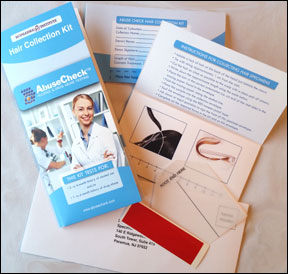
The non-invasive sampling requires 200 strands of hair. The longer the hair, the more information it provides. However, hair is limited to testing in only short (1 to 3 mo) segments. Acceptable lengths for 1 segment of head hair range from the shortest being 1.5 cm (providing about 1 month of history) to the longest being 3 cm (providing about 3 months of drug use history). Therefore, testing 4 segments of 3 cm can give you up to a year of drug use history. If head hair is not available, body hair may also be used for testing and can provide up to 1 year of drug use history.
For use in legal matters, the AbuseCheck™ HDT sample collection must be performed by a third party following proper chain of custody procedures. AbuseCheck has collection partners throughout the US and can help arrange for a legal hair collection for you.
|
4 Step Procedure:
Who is this test for?
Benefits:
|
Frequently Asked Questions (FAQs): Hair Drug Abuse Test
How much hair is needed for the hair drug test?
At least 60 milligrams of hair is needed for the hair drug test. This equals about 90-120 strands of hair (we prefer 200 strands), depending on the thickness of the hair. The hair must be at least 1.5 cm (or 0.6 inches) in length. If no head hair is available, body hair may be used.
What is the difference between the hair drug test and hair alcohol test?
The AbuseCheck™ hair alcohol test detects fatty acid ethyl esters (FAEEs), byproducts of alcohol metabolism, while the hair drug test detects 5 of the most common drug molecules and metabolites. The tests also require different amounts of sample, with the HAT requiring slightly more hair.
Can I take both the AbuseCheck™ Hair Alcohol Test and the Hair Drug Test?
Yes. You can order the two tests separately, or order the AbuseCheck™ Hair Testing Combination. Two separate hair samples will need to be collected, one for each test. The collections can occur at the same time.
Is the hair drug test accepted in court?
The hair drug test is widely accepted by the legal system.
Can hair treatments alter the hair drug test results?
No. Treatment of hair with hair products or hair coloring chemicals will not affect the accuracy of the hair drug test.
How does a hair drug test compare to a urine test?
Drug molecules and metabolites remain in the urine 2-3 days after drug use, while these molecules are permanently embedded in the structure of the hair. Therefore, analysis of hair samples gives a historical record of drug use up to 90 days.
How long after drug use can the drugs be detected in hair?
Drugs can be detected in head hair about 2 weeks after use. This is how long it takes for the hair to grow above the scalp.